


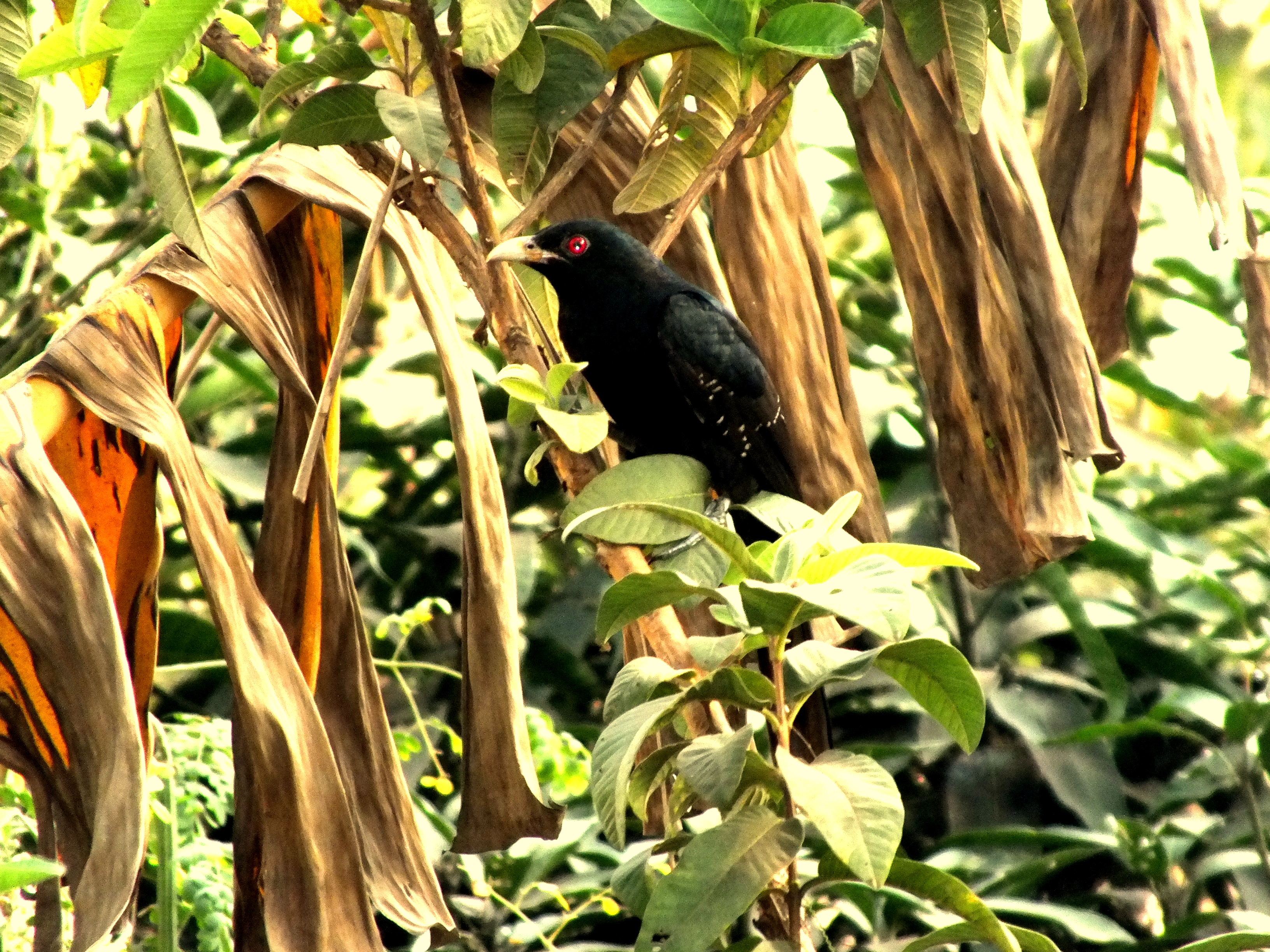
Archiu:Romanticized bird in literature - Asian Koel.jpg

Summary
| Description |
English: DID YOU KNOW!!!
When the Asian Koel sings.. Scientific name: Eudynamys scolopaceus Phylum: Chordata Higher classification: Koel Rank: Species As the most romanticised bird in literature, the Koel has been a common imagery of love. The Asian Koel was originally described by Linnaeus as Cuculus scolopaceus based on a specimen he received from the Malabar region. The species level taxonomy is complex and authors have proposed various taxonomic treatments. The Black-billed Koel (E. melanorhynchus) of the Sulawesi region and the Pacific Koel (E. orientalis) of Australasia are sometimes considered conspecific with the Asian Koel in which case the superspecies is known as the Common Koel (E. scolopaceus). Due to differences in plumage, colour of bill and voice, the three are increasingly treated as separate species. Alternatively, only the Black-billed Koel has been considered as a separate species, or the Asian Koel has included all subspecies otherwise included in the Pacific Koel, except for the subspecies breeding in Australia, which then has the name Australian Koel (E. cyanocephalus). The Asian Koel has several geographic forms that have well marked plumage differences or have been geographically isolated with little gene flow. The male Asian western koel has glossy bluish black plumage. The female is brownish with heavy pale buff and white streaking allover. The underside is whitish with heavy stripping. The juveniles initially appear like the female and have blackish bill. The irises are dark red. The legs and feet are shiny gray. The bill is pale creamy green. These species are very vocal, specially during breeding season. The Asian western koel male call is a loud, repeated "koo-Ooo" sound. The female makes a shrill "kik-kik-kik" sound. Origin, geographical range and distribution The Asian western koel species are distributed in Oman, Pakistan, India, Nepal, Bhutan, Sri Lanka, Maldives, Myanmar, Thailand, Cambodia, Laos, Vietnam, Malaysia, Singapore, Brunei, Indonesia, Philippines and southeast China. Vagrant Asian western koels are found in Yemen, United Arab Emirates and Iran. In India, these Asian koel species are distributed in all the states. Breeding populations are distributed in the states of Jammu and Kashmir, Himachal Pradesh, Punjab, Haryana, Uttarakhand and Uttar Pradesh. Wintering populations are found in Andaman and nicobar Islands. Diet The Asian Koel is omnivorous, consuming a variety of insects, caterpillars, eggs and small vertebrates. Adults feed mainly on fruit. They will sometimes defend fruiting trees that they forage in and chase away other frugivores. They have been noted to be especially important in the dispersal of the sandalwood tree (Santalum album) in India. Large seeded fruits are sometimes quickly regurgitated near the parent tree while small seeded fruits are ingested and are likely to be deposited at greater distances from the parent tree. They have a large gape and are capable of swallowing large fruits including the hard fruit of palms such as Arenga and Livistona. They have occasionally been known to take eggs of small birds. They feed on the fruits of Thevetia peruviana which are known to be toxic to mammals. Reproduction and breeding habits These Asian western koels are brood parasites, laying eggs in the nest of other birds and rely on the host to raise their young. The breeding season coincides with breeding season of the local host species. The breeding season of these Asian koels is from March to August in India and Pakistan. The laying season is from April to August in Sri Lanka. The breeding season is from February to April in Malaysia. The long-tailed shrikes (Lanius schach), common house crows (Corvus splendens) and common Mynas (Acridotheres tristis) are the common host species of the Asian western koel in the Indian continent. The eggs of these Asian species hatch one or two days before the host eggs. |
| Date | |
| Source | Own work |
| Author | Shiv's fotografia |
Licensing


- You are free:
- to share – to copy, distribute and transmit the work
- to remix – to adapt the work
- Under the following conditions:
- attribution – You must give appropriate credit, provide a link to the license, and indicate if changes were made. You may do so in any reasonable manner, but not in any way that suggests the licensor endorses you or your use.
- share alike – If you remix, transform, or build upon the material, you must distribute your contributions under the same or compatible license as the original.
Historial de l'image
Puncha en la data/hora per a vore l'image tal i com es mostrava en eixe moment.
| Data/Hora | Miniatura | Dimensions | Usuari | Descripció | |
|---|---|---|---|---|---|
| actual | 05:50 12 dec 2017 | Sense miniatura | 3264 × 2448 (4,86 MB) | wikimediacommons>Shiv's fotografia | User created page with UploadWizard |
Enllaços a l'image
Les següents pàgines enllacen ad esta image:
